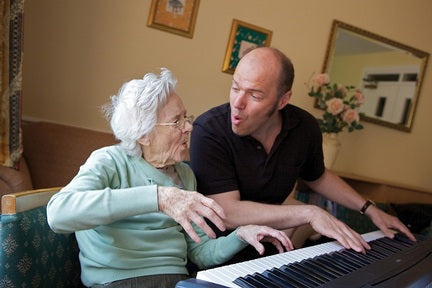
Studies show that music is a powerful stimulant for the brain, both emotionally and cognitively. This explains why music is a preferred intervention tool in the treatment of people with dementia. Even when cognition, semantics, comprehension, working memory, and information processing disappear, music reaches emotions from areas of the brain where neuronal activity is still active, in whole or in part.
Regardless of the cause of dementia, it is the transfer of information from short-term to long-term memory that is disrupted. Retaining new information becomes impossible. Caregivers then look for strategies to effect this transfer from one memory to another.
Strategies that succeed in doing so aim to create associations, emotional reactions, mood improvement; use repetition, organization and structuring of information; and even humor. Many of these concepts are found in music, which would explain its effectiveness as a trigger for recall.
The connections of the auditory nerve to key limbic structures in the brain explain the emotional charge produced by hearing familiar music. The limbic area of the midbrain participates in long-term memory storage and emotion processing. Because memories persist when they have significant personal connotations for the individual, and because the brain's processing of familiar music seems to bypass higher cortical structures, it is possible to reach the "sense of self" in a person with dementia by using music meaningful to them.
Using a familiar tune as a memory trigger in dementia treatment brings back past memories, helps affected individuals regain their "sense of self", especially if it evokes emotions linked to an experience that played an important and meaningful role for them.
There are several reasons why music is an ideal choice to help people with dementia:
- Music maintains and stimulates memory.
- Music used individually can reduce agitated or combative behaviors.
- Music used individually helps rebuild identity and preserves the "sense of self".
- Music is a non-verbal mode of expression and communication that speaks to emotions and feelings.
- Music is an aesthetic experience that reintroduces beauty and spirituality into existence.
- Music could have a positive effect promoting the prolongation of the ability to make connections and adopt appropriate behavior.
- Caregivers can easily incorporate music into their care.
- Making music meets the psychosocial needs of people with dementia such as: comfort, attachment, inclusion, occupation.
- Music allows connections in all areas.
- Music contributes to quality of life by promoting socialization.


